



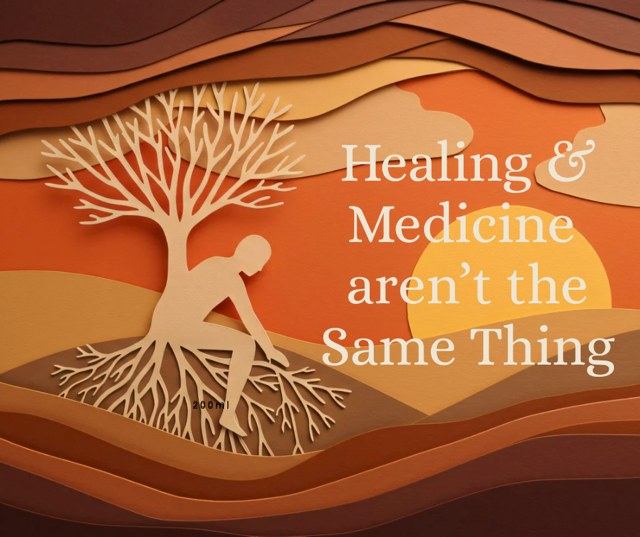
07 Jan Healing & Medicine aren’t the Same Thing
In our culture, healing is often understood as something that happens to us. We get sick, we seek treatment, and we hope to be returned to normal. In this framework, medicine becomes synonymous with healing — the intervention that will fix what has gone wrong.
But healing is not the same as medical treatment. While they can work together, they are not identical processes. Understanding the difference can profoundly change how we relate to our bodies, illness, and recovery.
A useful way to hold this distinction is simple:
Medicine moves us from minus to zero; healing carries us from zero to beyond.
Healing happens from within; medicine comes from without.
What “Minus to Zero” Really Means
When the body is overwhelmed — by illness, injury, infection, or prolonged stress — it often operates in a negative state. Energy is diverted toward survival. Systems compensate. Symptoms arise not because the body is failing, but because it is working hard under strain.
Medicine is designed to intervene in these states. Its role is to stabilize, suppress, replace, or correct. It may reduce pain, manage inflammation, interrupt destructive processes, or compensate for what the body cannot currently do on its own.
In doing so, medicine can be effective at stopping the downward slide in an emergency situation. But we didn’t get to crisis point in our health from thriving, our systems were already struggling.
This is the work of moving the system from minus to zero — from crisis toward baseline, from chaos toward stability. Zero is not insignificant. It is the point at which the body is no longer fighting just to survive.
But zero is not yet healing.
Zero Is Not Wholeness
Reaching zero often brings some relief. Symptoms may lessen. Life becomes more manageable. Yet many people discover that even when tests normalize or treatments “work,” something still feels unfinished.
Energy does not fully return. Nagging symptoms linger, resilience remains fragile. The body may feel guarded, depleted, or easily overwhelmed. This experience is especially familiar to people living with chronic illness, long-term stress, or nervous system dysregulation.
This is because zero represents stability/survival, not nourishment.
The medical system is not designed to take us beyond zero. Its methodology is oriented toward identifying problems and intervening to correct them. Once the immediate issue is addressed, the work is considered complete.
But healing — in the deeper sense — begins where medicine often stops.
Healing Happens Beyond Zero
Healing is not merely the absence of disease. It is a process of restoration, reorganization, and integration that unfolds within the body itself.
Cells repair. Tissues regenerate. Immune responses recalibrate. The nervous system reorganizes. These are not actions performed by medicine; they are intrinsic biological processes.
Healing happens when the body has enough:
- energy
- safety
- rest
- nourishment
- rhythm
- support
to do this work.
The body heals (as much as it can) when the environment is right.
Healing is an environmental response. When the internal terrain becomes more supportive than demanding, the body can move beyond mere stability into renewal.
This is the movement from zero to beyond.
The Inner Environment Matters as Much as the Outer One
The “environment” is not only external — food, air, or toxins — but internal as well. The nervous system plays a central role in determining whether healing is possible.
If the nervous system perceives:
- constant urgency
- pressure to perform
- fear of symptoms
- a need to push or override
the body remains in survival mode, even if medical interventions have reduced symptoms.
From a somatic perspective, practices that support rest, embodied awareness, rhythm, and reduced effort are not optional extras. They are ways of signaling to the body that it is safe enough to shift from protection into repair.
Healing cannot be rushed. It requires time, safety, and permission.
Healing Is Not the Same as Cure
Importantly, moving beyond zero does not always mean a cure. Healing is not linear, and it does not guarantee the disappearance of symptoms.
Healing can look like:
- greater capacity and resilience
- less internal struggle
- improved regulation
- deeper connection to the body
- a sense of wholeness, even with limitations
This understanding removes blame and pressure. It acknowledges that bodies heal according to their own histories and timelines, and that not all healing is visible or measurable.
A Different Relationship With the Body
When we understand healing this way, our relationship with the body changes.
Instead of asking, “What can I take to fix this?”
we begin to ask, “What conditions does my body need in order to heal?”
This might mean:
- doing less rather than more
- prioritizing rest and recovery
- nourishing rather than forcing
- listening rather than overriding
Medicine may help us reach zero.
But healing — real healing — unfolds from within, when the body is supported enough to rise.
A Closing Reflection
Perhaps the most compassionate reframe is this:
Medicine can stop the fall.
Healing begins when the body has the space and support to rise.
We cannot force that rise.
But we can create the conditions that invite it — patiently, respectfully, and in partnership with the body’s own intelligence.
Sorry, the comment form is closed at this time.